Best Tinnitus Relief Kit Under $50: What's Worth Buying
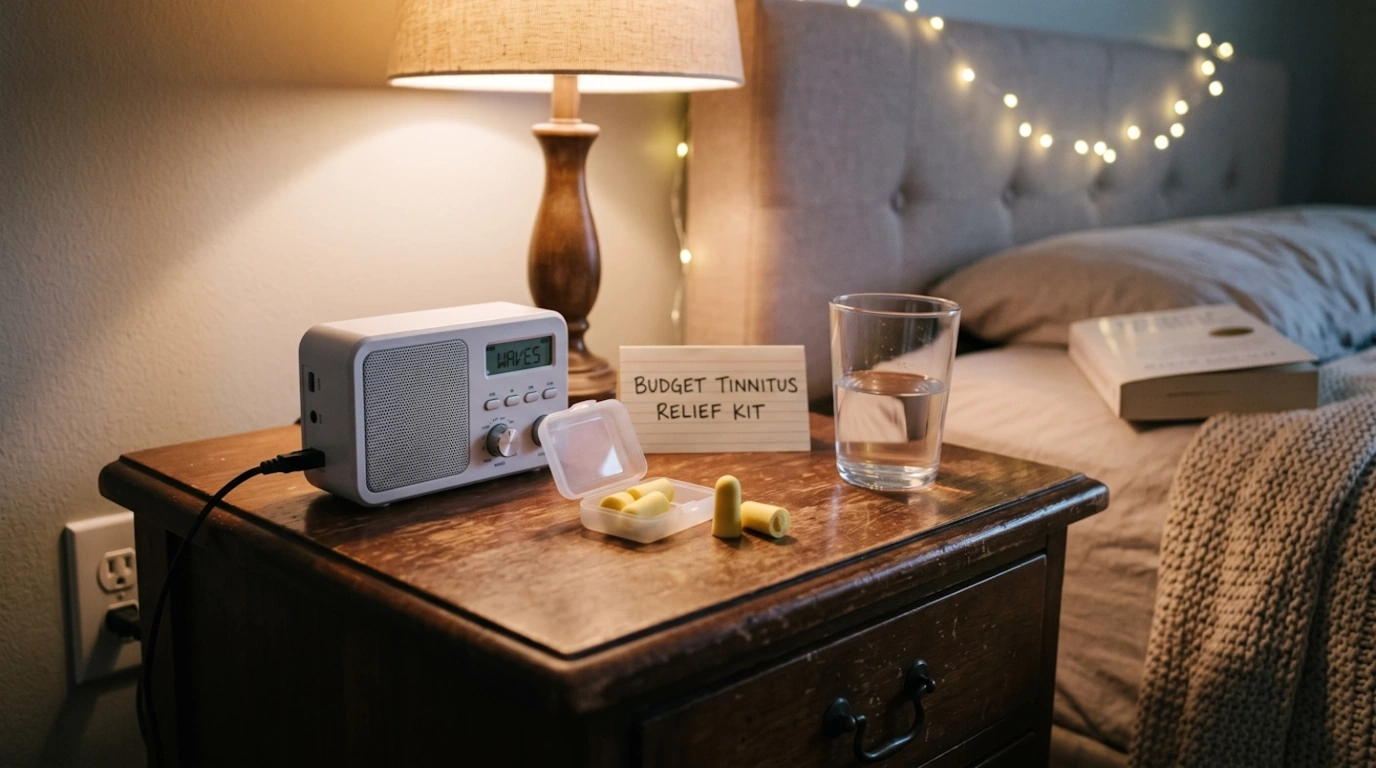
Search "tinnitus relief kit" and you'll find everything from $19 sound-therapy apps to $150 bundles promising to "silence the ringing for good." Most people don't need the expensive version, and a fair number of the cheap ones oversell what they can do. This guide breaks down what actually belongs in a low-cost tinnitus kit, what each category realistically does, and how to put together something useful for under $50 — without paying for ingredients or gadgets that don't have much behind them.
What a Tinnitus Relief Kit Can Realistically Do
It's worth saying plainly before anything else: no kit under $50 — or under $500, for that matter — cures tinnitus. Nothing sold over the counter reliably reverses the underlying cause, whether that's noise-related hair cell damage, age-related hearing changes, or something else. That's true of a $19 app and a $150 "complete tinnitus system" alike, and any product claiming otherwise is worth treating skeptically.
What a well-chosen, low-cost kit can do is narrower but genuinely useful: reduce the odds of new noise-related damage, make the ringing easier to tune out day to day, and improve sleep quality, which tends to have an outsized effect on how bothersome tinnitus feels overall. Clinical guidelines on tinnitus management consistently point to sound-based therapy and stress/sleep management as reasonable first-line, low-risk tools — which happens to line up well with what fits comfortably under a $50 budget.
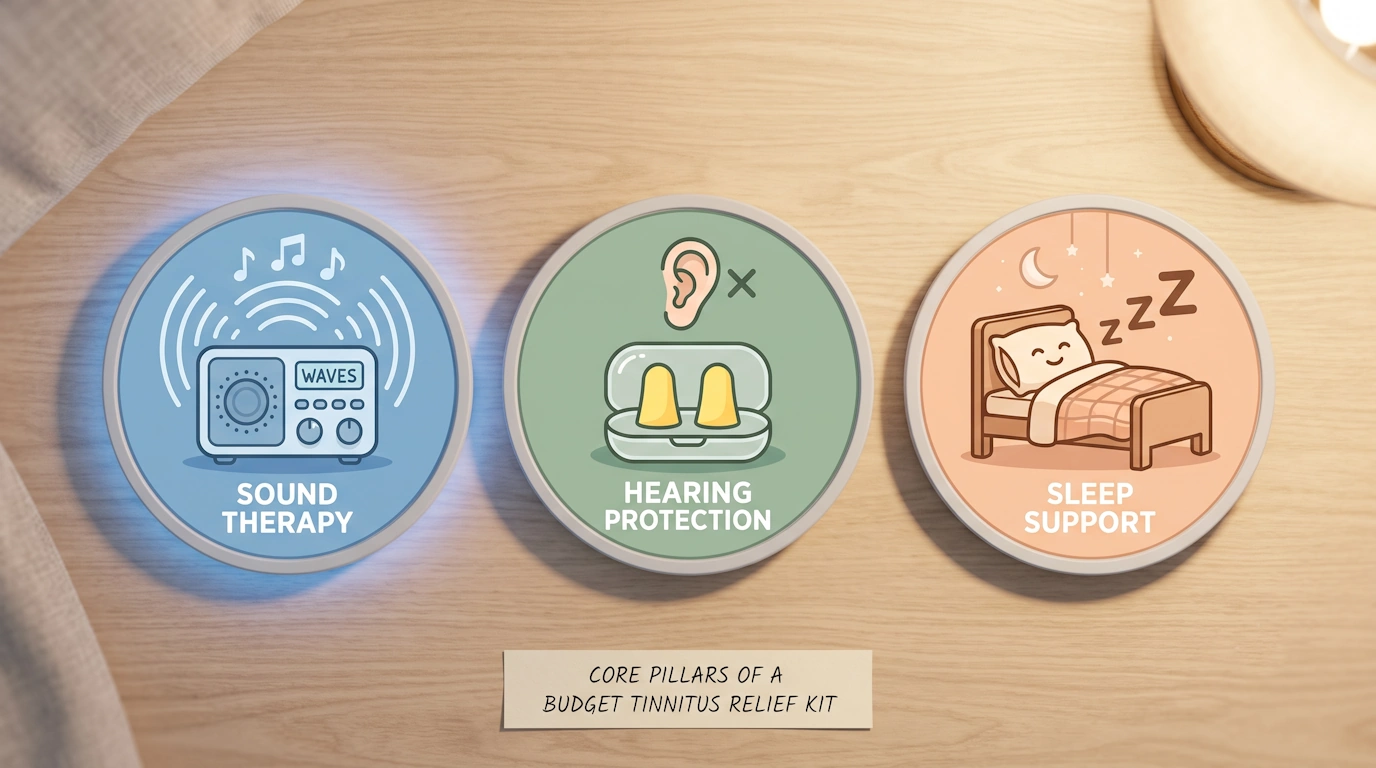
Quick Answer — Best Budget Kit Setup
The simplest kit that covers the essentials
- Sound therapy
- A free or low-cost white-noise/nature-sounds app, or a $10-$25 bedside sound machine if you'd rather not rely on your phone overnight.
- Hearing protection
- A pair of foam or high-fidelity earplugs ($10-$20) for concerts, tools, or other genuinely loud environments — see our full earplugs guide for picking the right type.
- Sleep support
- Often just the sound machine above, plus a consistent wind-down routine — no purchase required.
- Optional supplement
- Add one, not several, only if a specific factor (like a known low magnesium or zinc intake) applies to you — not as a default addition.
That combination — an app or sound machine plus one pair of earplugs — typically lands well under $50 on its own, sometimes under $20. The rest of this guide walks through why those two categories carry the most weight, what else is worth considering, and where the "kit" framing on some products stretches further than the evidence supports.
What to Include in a Budget Tinnitus Kit
Pre-packaged "tinnitus relief kits" sold online often bundle in five or six items to justify a higher price tag. In practice, most of the value comes from a smaller set of categories. Here's what each one is actually for.
Sound Therapy Option
Sound therapy works on a simple principle: introducing a low-level, non-intrusive background sound reduces the contrast between silence and the ringing, which for many people makes tinnitus less noticeable and less distressing — particularly at night, when a quiet room tends to make ringing feel louder. This can be a free phone app playing white noise, brown noise, or nature sounds; a dedicated sound machine; or even a fan or box fan, which costs nothing extra if you already own one. There's no strong evidence that a paid, "clinically designed" sound therapy app outperforms a well-chosen free one for basic masking purposes — the mechanism is the background sound itself, not the branding.
Hearing Protection
Reducing exposure to loud noise is one of the few genuinely evidence-backed ways to lower the odds of new tinnitus or a worsening of existing ringing, since acoustic trauma to the cochlea's hair cells is a well-documented trigger. A single pair of decent earplugs, used strategically around concerts, power tools, or other loud environments, is one of the highest-value, lowest-cost items in this entire category. We cover the type-by-type breakdown — including the important caution against wearing earplugs constantly in quiet settings — in our dedicated guide to earplugs for tinnitus prevention.
Sleep Support
Poor sleep and tinnitus distress tend to feed each other — tinnitus can make it harder to fall asleep, and poor sleep tends to make tinnitus feel more intrusive the next day. Budget sleep support usually overlaps directly with the sound therapy item above: a bedside sound machine or app running through the night addresses both categories at once. Beyond that, low-cost, low-risk additions like blackout curtains, a consistent bedtime, or reducing screen time before bed do more for most people than an additional purchase would.
Optional Supplement
Supplements are the most optional item on this list, and the one most worth being selective about. Magnesium, zinc, and B-vitamin deficiencies have each been studied in connection with tinnitus risk in specific populations, but the research generally supports correcting an actual deficiency or relevant risk factor — not taking a supplement "just in case" with no particular reason to. If you do add one, a single, moderately dosed, single-ingredient product is usually a better use of a tight budget than a multi-ingredient proprietary blend, both because it's cheaper per bottle and because it's easier to know what you're actually taking.
Best Items Under $50 by Category
Here's a category-by-category look at what a reasonable purchase looks like, and roughly what it should cost.
Best Sound Therapy Picks
Low cost, low riskFree apps with white noise, brown noise, and nature-sound libraries cover most people's needs at no cost. If you'd rather not run your phone overnight, a basic plug-in or battery-powered sound machine typically runs $15-$30 and avoids the temptation to check notifications in bed. Bluetooth pillow speakers are a middle option, useful for people who don't want a speaker audible to a partner, and usually fall in the $20-$40 range.
Best Earplugs for Noise Triggers
High value for the costA multi-pack of foam earplugs ($5-$15) covers power tools, yard equipment, and other high-decibel work. If concerts or live music are more your situation, a single pair of high-fidelity flat-attenuation earplugs ($15-$40) preserves sound quality while still lowering volume, which matters because people are far more likely to actually keep them in for the whole event. Our earplugs guide breaks down which type fits which scenario in more detail, including a full comparison table.
Best Sleep-Focused Items
Comfort-driven, individual variationBeyond a sound machine, a comfortable sleep mask ($5-$15) and, for side-sleepers, a low-profile silicone earplug rather than a bulky foam one ($10-$20) round out a basic sleep setup. These are comfort and consistency purchases more than clinically studied interventions — worth including if they help you stick with a nightly sound-therapy routine, skippable if they don't change your experience.
Best Low-Cost Supplement Option
Optional, situationalIf you're going to add one supplement, a single-ingredient magnesium or zinc product ($8-$20 for a month's supply) is generally the most defensible budget pick, provided there's a reasonable basis for taking it (known low dietary intake, a healthcare provider's suggestion, or a documented deficiency) rather than a blanket assumption that more supplementation equals less ringing. This is also where it's worth naming a well-known comparison point: Lipo-Flavonoid, a long-running over-the-counter product built around a moderate zinc dose alongside lipotropic and B-vitamin ingredients, is often what people are already comparing budget options against. It's a reasonable single-purchase option in the same price range as a standalone zinc supplement, though — like every product in this category — it doesn't have a large clinical trial proving it reduces tinnitus for the general population. If cost is the deciding factor, a plain zinc or magnesium supplement and a Lipo-Flavonoid-style multi-ingredient product are functionally similar bets at a similar price, and neither should be treated as a guaranteed fix.
A multi-bottle bundle of a broader formula like Audifort (commonly listed in the $49-$79 per-bottle range, dropping to about $49/bottle on larger bundles) sits above a true "under $50 total kit" budget once you're buying more than a single bottle, so it's worth thinking of that category as a separate, larger purchase decision rather than a line item inside a minimal starter kit — see our full ingredient breakdown on the Audifort review homepage if you're weighing that option specifically.
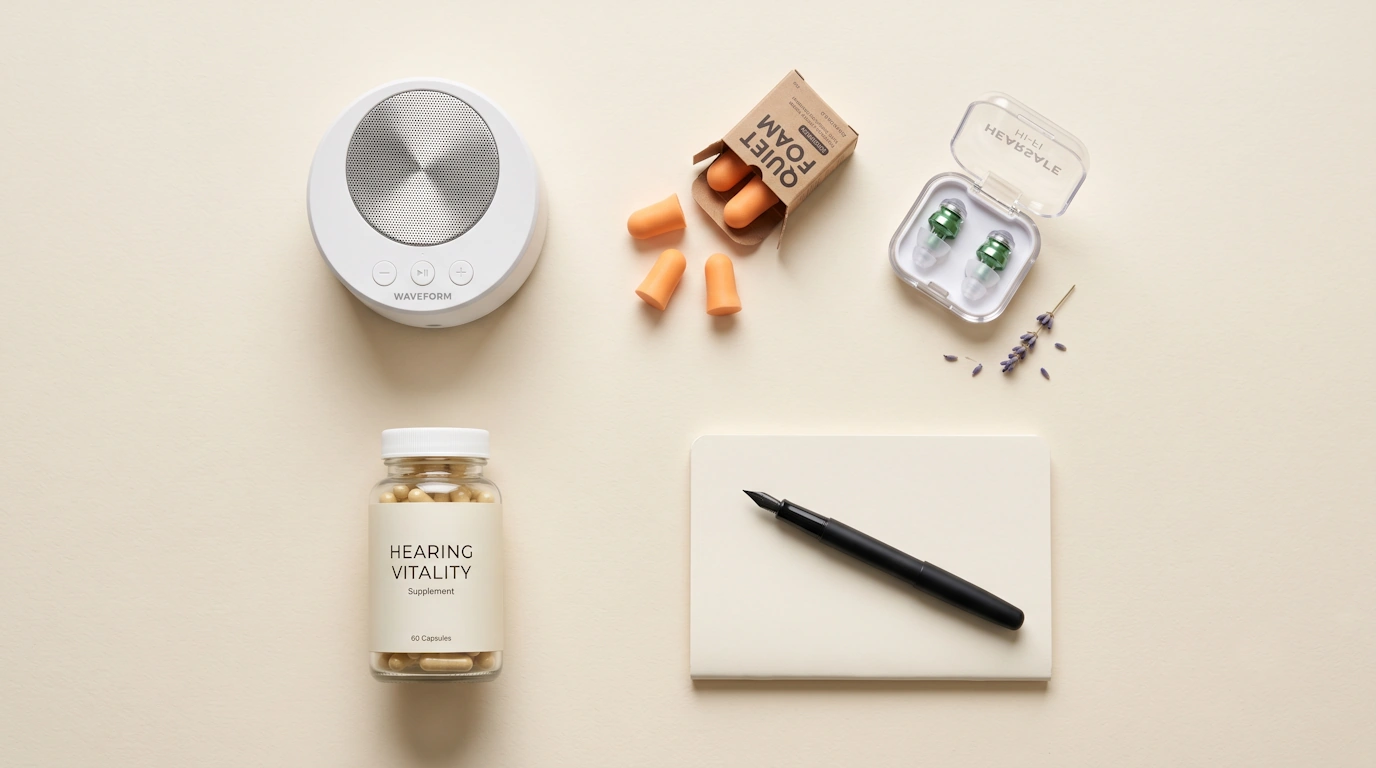
What Actually Helps and What Is Mostly Marketing
Not every item marketed toward tinnitus sufferers carries the same weight. It's worth separating the categories with genuine, if modest, evidence behind them from the ones riding mostly on hopeful framing.
Highest-Value Purchases
Sound therapy and hearing protection are consistently the two categories referenced in clinical tinnitus management guidance, and both are inexpensive, low-risk, and easy to start using immediately. If you're deciding where to spend your first $20-$30, these are it.
Lower-Value Purchases
Be more skeptical of: multi-ingredient "tinnitus formulas" with undisclosed individual doses, standalone gadgets marketed as "hearing support" devices with no published research behind the specific mechanism claimed, and anything using language like "cure," "reverse," or "permanently silence." None of these claims currently has strong clinical trial support for a finished product, and paying a premium for the packaging rather than the ingredient or tool itself is where most of the wasted spend in this category happens.
How to Build Your Own Kit for Less Than $50
Rather than buying a pre-bundled kit, it's often cheaper and more useful to assemble three or four items matched to your specific triggers. Here are three sample combinations.
Sleep-Focused Kit
Bedside sound machine ($20) + comfortable low-profile silicone earplugs for side-sleeping ($12) + a consistent wind-down routine (free). Total: roughly $32, leaving room for a modest supplement if there's a specific reason to add one.
Noise-Trigger Kit
High-fidelity flat-attenuation earplugs for concerts and social settings ($25) + a multi-pack of foam earplugs for yard work or power tools ($10) + a free sound-therapy app as a backup for quiet moments (free). Total: roughly $35.
Travel or Work Kit
Reusable, low-profile earplugs for commuting or flights ($20) + a Bluetooth pillow speaker or compact sound-therapy speaker for hotel stays ($25) + a free sound app for daytime use (free). Total: roughly $45.
All three stay under $50 and can be adjusted up or down — dropping the sleep speaker in favor of a free app, for instance, brings any of these closer to $20.
Safety, Side Effects, and Who Should Be Careful
A budget kit is generally low-risk, but a couple of categories deserve a closer look before you buy.
Supplement Cautions
Magnesium in high doses can cause digestive upset and, in people with kidney impairment, more serious complications, since the kidneys are what normally clear excess magnesium. Zinc taken long-term at high doses can interfere with copper absorption and, in some cases, affect immune function — moderate, time-limited use is generally considered lower-risk than indefinite high-dose supplementation. Melatonin is generally well-tolerated short-term but can cause grogginess the next morning in some people and may interact with certain medications. As with any supplement, check with a doctor or pharmacist if you take prescription medication or have an existing kidney, liver, or immune condition.
When to Seek Medical Care
Sudden hearing loss — especially in one ear, which can be a medical urgency requiring prompt evaluation.
Tinnitus in one ear only — asymmetric tinnitus warrants a hearing evaluation to rule out causes beyond general noise exposure.
Pulsatile tinnitus — ringing that beats in time with your heartbeat is often vascular in origin and isn't something a sound-therapy or earplug kit addresses.
Dizziness alongside new tinnitus — this combination points toward inner-ear or balance-system involvement worth a professional look.
Significant distress or sleep disruption that a basic kit isn't touching — a starting point worth mentioning to a doctor is more useful than adding more products on your own.
Comparison Table — Best Budget Kit Components
| Item | Estimated Cost | Best Use Case | Evidence / Value |
|---|---|---|---|
| Free sound therapy app | $0 | Nighttime masking, quiet-room distress | Widely referenced in clinical guidance; no cost, no risk |
| Bedside sound machine | $15–$30 | Consistent nightly masking without a phone | Same mechanism as an app; convenience-driven upgrade |
| Foam earplugs | $5–$15 | Power tools, yard equipment, hazardous noise | Strong, well-established protective value |
| High-fidelity earplugs | $15–$40 | Concerts, live music, social noise | Population studies show reduced post-event tinnitus and threshold shifts |
| Single-ingredient supplement (magnesium or zinc) | $8–$20/month | Only if a relevant deficiency or risk factor applies | Situational; not a default addition |
| Multi-ingredient "tinnitus formula" blends | $40–$80+/bottle | People wanting a broader, all-in-one supplement approach | No finished-formula clinical trial for most products; higher cost per category covered |
Where this leaves things: the first three rows of this table — a free app, foam earplugs, and high-fidelity earplugs — already cover the highest-value ground for well under $50 combined. Everything after that is a situational add-on, not a requirement.
Frequently Asked Questions
What is the best tinnitus relief kit under $50?+
Can a cheap tinnitus kit actually help?+
Should I buy earplugs or a sound machine first?+
Are tinnitus supplements worth it on a budget?+
What should I avoid when buying tinnitus products?+
Can I build my own tinnitus kit for less than $50?+
Final Recommendation
The best budget tinnitus relief kit usually isn't a pre-packaged bundle at all — it's a free or low-cost sound therapy option paired with one well-chosen pair of earplugs, assembled to match your actual triggers rather than a generic list. That combination covers the two categories with the most consistent backing in clinical guidance, typically for well under $50, and leaves room to add a single, carefully chosen supplement later if a specific reason to do so comes up.
Start with sound and protection, see how that changes your day-to-day experience over a few weeks, and treat anything beyond that — including broader supplement blends like Audifort — as a separate, considered purchase rather than a default add-on. And if symptoms are severe, one-sided, or paired with dizziness or sudden changes, a doctor or audiologist is the next right step, not a bigger kit.
Curious What's Inside a Broader Oral Tinnitus Formula?
See Audifort's full ingredient-by-ingredient evidence breakdown and current bundle pricing, backed by a 60-day money-back guarantee.
Check Audifort Pricing →Affiliate link — we may earn a commission at no extra cost to you.
For a full look at oral supplement ingredients and evidence strength, see our ingredient breakdown on the Audifort review homepage.
Sources & References
This article draws on the following clinical guidance, government resources, and published research. We link directly to each source so you can read the original material rather than take our summary on faith.
- "What Is Tinnitus? — Causes and Treatment." National Institute on Deafness and Other Communication Disorders (NIDCD), National Institutes of Health. nidcd.nih.gov
- "Clinical Practice Guideline: Tinnitus." American Academy of Otolaryngology–Head and Neck Surgery Foundation. enttoday.org
- "Provide Hearing Protection." Noise and Hearing Loss, Centers for Disease Control and Prevention (CDC/NIOSH). cdc.gov
- "Sound Therapy and Tinnitus." American Tinnitus Association. ata.org
- "Magnesium — Fact Sheet for Health Professionals." National Institutes of Health, Office of Dietary Supplements. ods.od.nih.gov
- "Zinc — Fact Sheet for Health Professionals." National Institutes of Health, Office of Dietary Supplements. ods.od.nih.gov
- "Melatonin: What You Need to Know." National Center for Complementary and Integrative Health (NCCIH), NIH. nccih.nih.gov
- "Tinnitus and Sleep." Sleep Foundation. sleepfoundation.org
Pricing figures reflect commonly listed amounts for the product categories discussed at time of writing and fluctuate with ongoing promotions and retailer.