Ginkgo Biloba for Tinnitus: Evidence, Dosage, and Safety
Ginkgo biloba is probably the single herbal supplement most associated with tinnitus in the public imagination — mentioned in pharmacy aisles, forum threads, and more clinical trials than almost any other natural remedy for ringing ears. That volume of research should make this an easy question to answer. It doesn't. Depending on which systematic review you read, ginkgo either has real, if modest, evidence behind it, or none at all. Both conclusions come from credible scientists looking at overlapping data. Here's what's actually going on, what dosages the trials used, and what the safety profile looks like before you consider trying it.
Why People Try Ginkgo Biloba for Tinnitus
Tinnitus — the perception of ringing, buzzing, hissing, or humming with no external sound source — affects an estimated 10% to 15% of adults at some point, and a genuine cure is rarely available. Faced with limited pharmaceutical options, both patients and prescribers have long turned to ginkgo biloba, an extract from one of the oldest tree species on earth, traditionally used in Chinese medicine and sold worldwide as a standardized supplement for circulation and cognitive support.
Ginkgo's association with tinnitus isn't a recent internet trend — it's been the subject of clinical trials since the 1990s and remains one of the most frequently prescribed non-drug tinnitus treatments in parts of Europe. That track record is exactly why it's worth examining carefully: a supplement can be widely used and still not be well proven, and ginkgo is a genuinely useful case study in why those two things aren't the same.
Quick Answer — What the Research Suggests
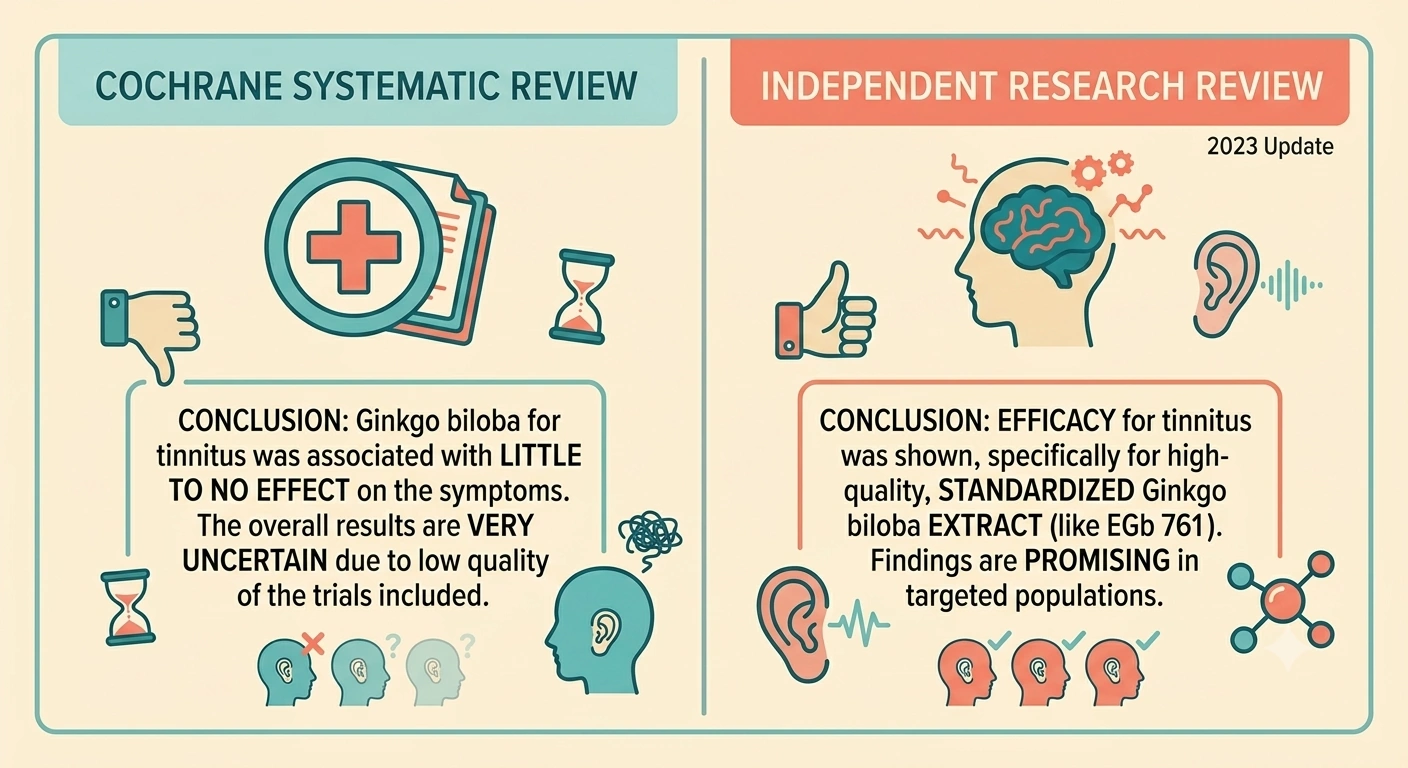
The evidence is genuinely mixed, and which conclusion you land on depends partly on which extract you're asking about. A large 2022 Cochrane review pooling 12 trials and nearly 2,000 participants found ginkgo "may have little to no effect" on tinnitus severity, calling the evidence very uncertain. A separate systematic review of the same general research area concluded there is evidence of efficacy specifically for the standardized extract EGb 761, based on three trials where tinnitus was the primary complaint — while noting that other, non-standardized ginkgo products haven't shown proven benefit.
Ginkgo biloba is not a guaranteed fix for tinnitus. It's a supplement with a longer and more rigorously studied track record than most tinnitus remedies, a plausible mechanism, and a real but unresolved efficacy question — which is a different, more honest position than either "proven" or "worthless."
How Ginkgo Biloba Is Supposed to Work
Ginkgo leaf extract contains two main groups of active compounds: flavone glycosides (antioxidant plant pigments) and terpene lactones, including a set of compounds called ginkgolides that are largely unique to the ginkgo tree. Researchers have proposed several overlapping mechanisms for how these compounds might affect tinnitus, though none has been definitively confirmed as the reason for any clinical effect seen in trials.
Blood Flow and Inner Ear Support
The most commonly cited mechanism is circulatory. Ginkgo is used medically to improve blood flow, including microcirculation in small vessels, and some researchers have proposed this could help the inner ear "habituate," or adjust to, phantom noise signals by improving local blood supply to the cochlea and auditory pathways. This is the same circulation-based logic behind why ginkgo is studied for cerebral insufficiency and peripheral vascular symptoms more broadly, and it's the rationale most often given in older tinnitus trials.
Antioxidant and Neuroprotective Effects
Ginkgo's flavone glycosides have measurable antioxidant activity, which some researchers connect to a broader oxidative-stress theory of tinnitus — the idea that free radical damage to hair cells or auditory nerve tissue contributes to phantom sound perception. Ginkgo has also been studied for effects on platelet-activating factor and inflammatory signaling, proposed as secondary pathways relevant to nerve protection. As with the circulation theory, this is a plausible mechanism supported by laboratory and animal research rather than confirmed as the operative pathway in humans with tinnitus specifically.
What the Studies Say About Ginkgo and Tinnitus
This is the section where "the evidence is mixed" stops being a hedge and starts being the actual finding. Here's what the major reviews and trials show, in roughly chronological order of the debate.
| Review / Trial | Scope | Finding |
|---|---|---|
| Cochrane review, 2022 update | 12 trials, 1,915 participants | Ginkgo "may have little to no effect" on tinnitus symptom severity; evidence rated very uncertain due to high or unclear risk of bias in most included trials. |
| Cochrane review, 2013 update | 4 trials, 1,543 participants, low risk of bias | No evidence that ginkgo is effective for tinnitus when tinnitus is the primary complaint. |
| von Boetticher systematic review, 2011 | 3 primary-complaint trials of standardized EGb 761 | Evidence of efficacy for the standardized extract specifically; author argued the Cochrane review's trial selection included flawed studies and excluded supportive ones. |
| Individual EGb 761 RCTs, various years | 120–240 mg/day, 12–24 week trials | Several individual trials reported significant within-group and some between-group improvements on tinnitus questionnaires; others found no significant difference versus placebo or an active comparator. |
Takeaway: the two Cochrane updates and the independent systematic review disagree — not because one side ignored data, but because they weighed trial quality and extract standardization differently. If you only read a headline, you could walk away thinking ginkgo is either proven or debunked. Neither is accurate.
A 2024 retrospective cohort study added a different kind of data point: it found that patients prescribed EGb 761 for tinnitus had fewer repeat visits to ENT doctors for the condition than similar patients who weren't prescribed it. That's real-world observational data, not a randomized trial, so it can't establish cause and effect the way an RCT can — people prescribed ginkgo may differ from those who weren't in ways the study couldn't fully control for. But it's a signal worth noting alongside the trial data rather than in place of it.
Who May Respond Better
No study has definitively identified who responds best to ginkgo, but a few patterns recur across individual trials: effects concentrated in people with hearing loss alongside their tinnitus, or in those whose tinnitus is linked to vascular or circulation-related causes rather than pure noise-induced damage. An exploratory 2025 study using EGb 761 also examined whether comorbidities like anxiety, depression, or hearing impairment changed how people responded, on the theory that ginkgo's broader effects on mood and cognition might indirectly influence perceived tinnitus severity. None of this is a validated way to predict who will benefit — it describes where promising signals have clustered, not a diagnostic test.
Limits of Current Research
A few recurring problems explain why the picture stays muddy: many older trials used ginkgo preparations that weren't standardized or clearly described, which the von Boetticher review flagged as a likely reason for inconsistent results. Sample sizes are often small enough that a real but modest effect could easily be missed. Trial durations vary from 12 to 24 weeks, and tinnitus is known for a strong placebo response and natural fluctuation, which makes shorter trials especially hard to interpret. And tinnitus itself has many different underlying causes lumped into one symptom category, so a treatment that helps circulation-related tinnitus might show no effect when averaged across a trial population that also includes noise-induced and idiopathic cases.
Best Ginkgo Biloba Forms for Tinnitus
If extract standardization is genuinely a factor in why some trials show benefit and others don't, then which product you buy matters more for ginkgo than it does for many other supplements.
Standardization and Extract Quality
Nearly every ginkgo trial with a positive signal used EGb 761, a standardized extract manufactured to a fixed ratio: approximately 24% flavone glycosides and 6% terpene lactones, with strict limits on ginkgolic acid (a compound linked to allergic reactions). This isn't a brand preference — it's the specification used in the research base itself, so a product made with a different, unstandardized process is genuinely a different substance from what most trials tested, not just a different label.
What to Look for on the Label
At minimum, look for a stated standardization to roughly 24% flavone glycosides and 6% terpene lactones (sometimes shown as "24/6" ginkgo extract), or an explicit reference to EGb 761 or an equivalent pharmaceutical-grade extract. Also check for a stated ginkgolic acid limit (quality extracts keep this below 5 parts per million), a clear extraction ratio, and third-party testing. Products that only say "ginkgo biloba leaf powder" without any standardization percentage are the type the research base generally hasn't validated.
Dosage, Timing, and How Long It Takes
The dosage ranges below reflect what clinical trials actually used — not a personal recommendation. Follow product labeling and talk to a doctor or pharmacist before starting, especially if you take any other medication.
Typical Dosage Ranges
Trials studying ginkgo for tinnitus have most commonly used 120 mg to 240 mg per day of standardized EGb 761 extract, typically split into two doses of 120 mg taken twice daily rather than one large dose. Some dementia-focused trials that also tracked tinnitus as a secondary outcome used a single 240 mg once-daily formulation. Doses below 120 mg/day and above 240 mg/day are less represented in the tinnitus-specific research, so sticking within the studied range — and within whatever a product's own labeling recommends — is the more evidence-grounded approach.
When to Expect Results
Every trial referenced above ran for 12 to 24 weeks before assessing outcomes. None of the research supports a fast-acting or same-week effect. If you decide to try ginkgo, treating it as a multi-month trial — ideally with some way of tracking your symptoms before and after, like a simple tinnitus severity scale — makes more sense than judging it after a week or two, both because that matches how it was studied and because tinnitus itself naturally fluctuates in the short term regardless of treatment.
Side Effects and Safety Concerns
Ginkgo is generally well tolerated in clinical trials, but it isn't risk-free, and its risk profile is somewhat more involved than a typical vitamin or mineral supplement.
According to NIH's National Center for Complementary and Integrative Health (NCCIH), common side effects of ginkgo supplements include headache, nausea, gastrointestinal upset, diarrhea, dizziness, or allergic skin reactions, with more severe allergic reactions occasionally reported. NCCIH also notes there are data suggesting ginkgo can increase bleeding risk, which is the safety issue most consistently flagged across sources.
Medication Interactions
The most clinically significant interaction is with blood-thinning medication. NCCIH states that taking ginkgo with warfarin is associated with an increased risk of major bleeding events compared to warfarin alone. A 2025 retrospective analysis of over 2,600 prescriptions found ginkgo most frequently interacted with antiplatelet drugs, anticoagulants, and NSAIDs, with clopidogrel and aspirin showing the highest interaction rates — though a lab-based trial in that same analysis found EGb 761 didn't measurably inhibit blood coagulation or platelet aggregation directly, meaning the exact mechanism isn't fully settled even though the interaction itself is consistently flagged by regulators.
Beyond blood thinners, ginkgo may interact with NSAIDs like ibuprofen and aspirin (additive bleeding risk), certain anticonvulsants (ginkgo may reduce their effectiveness while separately raising seizure risk), some antidepressants, and diabetes medications by affecting blood sugar response. If you take any prescription medication, checking with a pharmacist before adding ginkgo is a reasonable, low-effort step.
Who Should Avoid Ginkgo
Are pregnant or breastfeeding — ginkgo is generally considered unsafe during pregnancy due to bleeding and premature labor risk, and safety during breastfeeding hasn't been well established.
Have epilepsy or a seizure disorder — large amounts of ginkgo may raise seizure risk, an effect linked to a compound called ginkgotoxin that can affect the balance between glutamate and GABA signaling in the brain.
Take blood thinners or antiplatelet medication — including warfarin, aspirin, or clopidogrel — due to increased bleeding risk.
Have upcoming surgery — most clinical guidance recommends stopping ginkgo roughly two weeks beforehand because of bleeding risk.
Have diabetes — ginkgo might affect blood sugar management, so closer monitoring is reasonable if you add it.
Ginkgo vs Other Tinnitus Supplements
Ginkgo isn't the only supplement people research for tinnitus. Here's a brief comparison — the right starting point depends heavily on what's likely causing your tinnitus, which none of these supplements can determine on their own.
- Ginkgo biloba vs magnesium: Magnesium's best evidence is for preventing noise-induced hearing damage, with more preliminary data for treating existing tinnitus. Ginkgo has a larger, older trial base focused specifically on treating existing tinnitus, but with a more contested overall verdict. See our zinc and magnesium deep dive for details.
- Ginkgo biloba vs zinc: Zinc's strongest evidence (a Cochrane review) found no general tinnitus benefit, with a possible exception limited to confirmed deficiency. Ginkgo's evidence base is larger and more actively debated rather than more settled.
- Ginkgo biloba vs melatonin: Melatonin is studied mainly for tinnitus-related sleep disruption rather than perceived loudness — a different target than ginkgo's circulation and antioxidant mechanisms.
- Ginkgo biloba vs NAC (N-acetylcysteine): NAC is researched primarily for preventing noise-induced hearing damage via antioxidant activity, similar in spirit to one of ginkgo's proposed mechanisms, but in a largely separate research literature with its own open questions.
None of these has a large, uncontested evidence base proving it treats tinnitus broadly. The honest framing across all of them is "worth discussing with a doctor as a low-risk option for a specific reason," not "proven remedy."
How to Choose a Quality Supplement
Because ginkgo is sold as a supplement rather than a regulated drug in most markets, quality varies substantially between brands — and for ginkgo specifically, that variation may directly affect whether it has any chance of working the way the research suggests.
What to Avoid
- Underdosed products — anything providing well under 120 mg/day of standardized extract falls below every dose used in tinnitus trials.
- Vague herbal blends — proprietary multi-herb formulas that list "ginkgo biloba" without a milligram amount or standardization percentage make it impossible to compare the product to the research.
- Exaggerated cure claims — any product claiming ginkgo "cures" or "eliminates" tinnitus is overstating what even the most favorable systematic reviews describe as an unresolved, modest-at-best effect.
- No ginkgolic acid disclosure — reputable standardized extracts disclose that ginkgolic acid (an allergen-associated compound) is kept below a strict limit; products that don't mention this at all are harder to evaluate for quality control.
When to See a Doctor About Tinnitus
Ginkgo biloba, like every supplement discussed on this site, is not a substitute for a medical evaluation — particularly because some causes of tinnitus need prompt attention rather than a multi-month supplement trial. See a doctor or audiologist, rather than starting with any supplement, if your tinnitus:
- Started suddenly, especially alongside any degree of hearing loss
- Occurs in only one ear
- Pulses or beats in time with your heartbeat (pulsatile tinnitus)
- Comes with dizziness, vertigo, or balance problems
- Is causing significant distress, sleep disruption, or difficulty concentrating
These patterns can point to causes — from earwax blockage to vascular issues to, rarely, more serious conditions — that benefit from a proper diagnosis rather than trial-and-error supplementation.
Frequently Asked Questions
Does ginkgo biloba help tinnitus?+
How much ginkgo biloba should I take for tinnitus?+
How long does ginkgo biloba take to work for tinnitus?+
Can ginkgo make tinnitus worse?+
Is ginkgo safe with blood thinners?+
What is the best ginkgo extract for tinnitus?+
Final Takeaway
Ginkgo biloba is one of the most-researched, most-debated supplements in tinnitus care, and that debate is genuinely unresolved rather than secretly settled in one direction. Cochrane's cautious, highest-volume 2022 review found little to no proven effect with very uncertain confidence. A separate, more targeted look at trials using the standardized EGb 761 extract found real evidence of efficacy in that better-defined subset of research. Both conclusions are defensible — they're answering slightly different questions with different evidence thresholds.
Ginkgo biloba is not part of Audifort's core formula, which is built around a different set of ingredients — worth knowing plainly rather than glossing over. If the research above makes ginkgo worth exploring, a standardized EGb 761-equivalent extract at a studied dose, discussed with a doctor first given its bleeding-risk and interaction profile, is the more evidence-aligned way to try it. Treating any identifiable underlying cause of your tinnitus remains the higher-leverage step regardless of which supplement you consider alongside it.
Curious What Audifort's Formula Actually Contains?
See the full ingredient-by-ingredient evidence breakdown, backed by a 60-day money-back guarantee.
Check Audifort Pricing →Affiliate link — we may earn a commission at no extra cost to you.
Sources & References
This article draws on the following peer-reviewed studies, systematic reviews, and government health resources. We link directly to each source so you can read the original research rather than take our summary on faith.
- Sereda M, Xia J, Scutt P, Hilton MP, El Refaie A, Hoare DJ. "Ginkgo biloba for tinnitus." Cochrane Database of Systematic Reviews, 2022. cochranelibrary.com
- Hilton MP, Zimmermann EF, Hunt WT. "Ginkgo biloba for tinnitus." Cochrane Database of Systematic Reviews, 2013 update. cochrane.org
- von Boetticher A. "Ginkgo biloba extract in the treatment of tinnitus: a systematic review." Neuropsychiatric Disease and Treatment, 2011. pmc.ncbi.nlm.nih.gov
- Morawski K, et al. "Ginkgo biloba Extract EGb 761® in Patients with Chronic Tinnitus: Treatment Effects and Effect Modifiers." Journal of Clinical Medicine, 2025. mdpi.com
- Frontiers in Neurology. "Ginkgo biloba extract prescriptions are associated with less frequent repeat visits to ENT doctors due to tinnitus: a retrospective cohort study." 2024. frontiersin.org
- Procházková K, Šejna I, Skutil J, Hahn A. "Ginkgo biloba extract EGb 761® versus pentoxifylline in chronic tinnitus: a randomized, double-blind clinical trial." International Journal of Clinical Pharmacy, 2018. ncbi.nlm.nih.gov
- "Ginkgo: Usefulness and Safety." National Institutes of Health, National Center for Complementary and Integrative Health. nccih.nih.gov
- "Herb-Drug Interactions: What the Science Says." National Institutes of Health, National Center for Complementary and Integrative Health. nccih.nih.gov
- Mai NTQ, et al. "Impact of Ginkgo biloba drug interactions on bleeding risk and coagulation profiles: A comprehensive analysis." PLOS ONE, 2025. journals.plos.org
- "Ginkgo." Mayo Clinic. mayoclinic.org
Citation #2 links to Cochrane's public evidence summary page for the 2013 review update rather than the full technical record; search "Hilton Zimmermann Hunt ginkgo biloba tinnitus Cochrane" to locate the complete review if the direct link has moved.