5 Daily Habits That Help Protect Your Hearing as You Age

Age-related hearing loss is remarkably common — and the habits you build today can meaningfully slow how quickly it progresses. This guide covers five evidence-grounded daily habits that help protect your hearing as you age, from simple volume choices to the routine health practices most people overlook entirely.
Why Hearing Protection Matters With Age
Age-related hearing loss — clinically called presbycusis — is one of the most prevalent conditions affecting adults over 50. According to the National Institute on Deafness and Other Communication Disorders (NIDCD), approximately one in three Americans between 65 and 74 has some degree of hearing loss, and that figure rises to nearly half of people over 75. The World Health Organization estimates that over one billion people worldwide are at risk of avoidable hearing loss from noise exposure alone.
The critical point is that while some hearing change with age is inevitable, the rate and degree of that change is heavily influenced by lifestyle. Decades of noise exposure, poor cardiovascular health, and infrequent screening don't cause aging — but they compound it. A 65-year-old who has protected their ears, maintained good circulation, and caught early changes through regular checkups will typically experience far less functional hearing loss than someone who hasn't, even though both have the same biological age.
The five habits below address the most controllable factors. None of them require expensive equipment or major life changes — just consistent, repeatable choices made across your daily routine.
Habit 1 — Keep Noise Exposure Low
Cumulative noise exposure is the single largest modifiable risk factor for hearing loss. Every loud environment you spend time in — concerts, power tools, heavy traffic, open-plan offices — adds to a lifetime total that your inner ear can't undo. The tiny hair cells inside the cochlea that convert sound into electrical signals for your brain don't regenerate once they're damaged; this makes prevention not just useful but irreplaceable.
Keeping daily noise exposure low doesn't mean living in silence. It means being deliberate: choosing lower volumes when you have the choice, limiting time in loud environments when you don't, and recognizing that small reductions in volume translate to large reductions in risk. According to NIOSH guidelines, every 3-decibel increase in sound level cuts the safe exposure time roughly in half — which means even modest volume reductions make a substantial difference over a lifetime of listening.
How Loud Is Too Loud?
Sound is measured in decibels (dB). NIOSH considers sustained exposure at or above 85 dB hazardous over an eight-hour workday — roughly the level of a lawnmower or heavy city traffic. At 94 dB (a motorcycle or busy nightclub), the safe exposure window drops to around one hour. At 110 dB (a typical rock concert), two minutes is enough to register risk. A practical rule of thumb: if you have to raise your voice to be heard by someone standing an arm's length away, the environment is likely loud enough to warrant protection or a shorter stay.
60–70 dB: Normal conversation, background music — safe for extended periods.
85 dB: Lawnmower, heavy traffic — limit unprotected exposure to 8 hours or less.
94 dB: Nightclub, power drill — limit to ~1 hour without protection.
110+ dB: Rock concert, chainsaw — safe window under 2 minutes; always use protection.
Habit 2 — Wear Hearing Protection When Needed
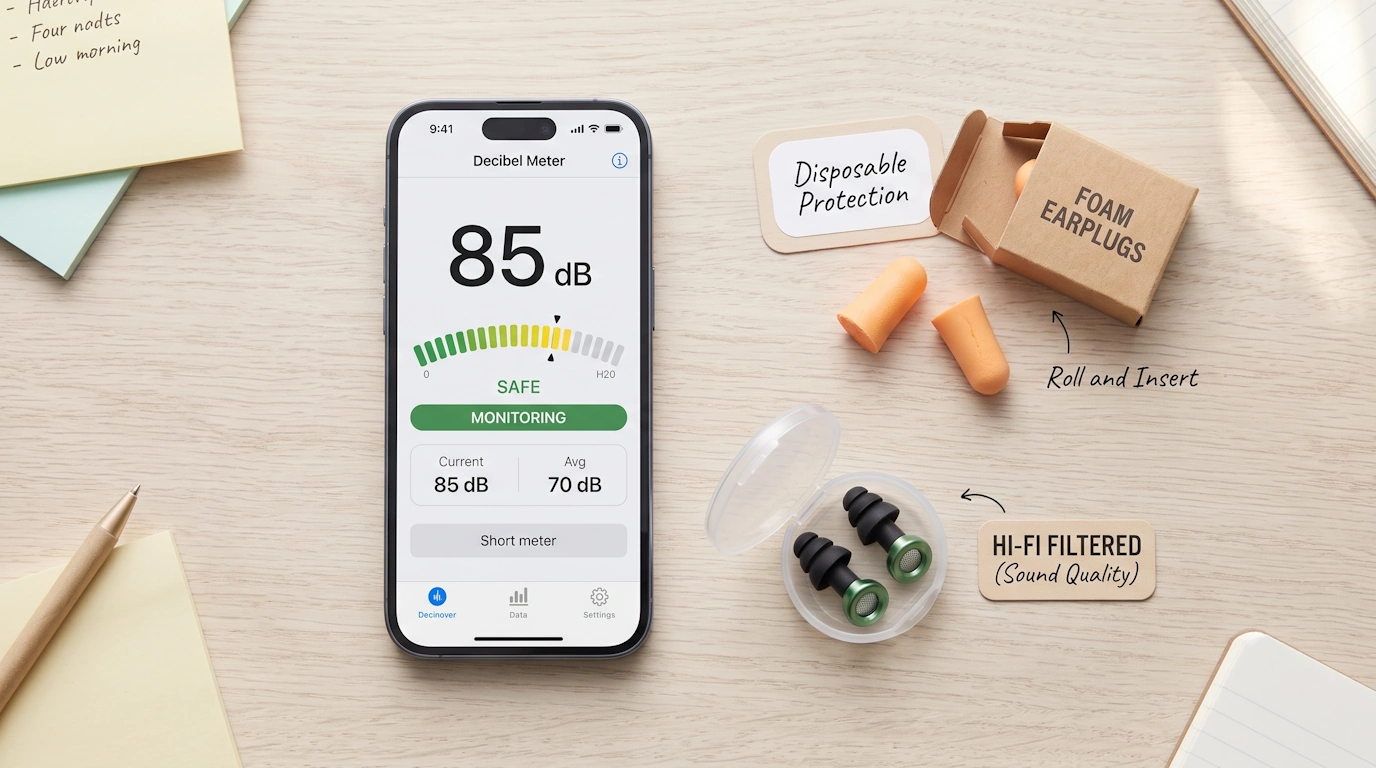
When you can't reduce the volume of an environment, the next best move is to reduce how much of it reaches your ears. Hearing protection — earplugs, earmuffs, or both — is the most direct and well-validated tool available for preventing noise-induced hearing loss, and it works whether you're 25 or 65. The habit is less about always wearing protection and more about having it when the moment calls for it, which means owning a pair you'll actually use and keeping it somewhere accessible.
For general noise exposure like yard work, power tools, and construction: standard foam earplugs provide strong attenuation and cost almost nothing. For concerts, live music, and other environments where you want to hear clearly while still being protected: high-fidelity or "musician's" earplugs use a filtered design that lowers volume evenly across frequencies so sound quality isn't sacrificed — which matters because people are far more likely to keep protection in for an entire event when it doesn't muffle the music they came to hear. For heavy industrial or sustained workshop use, over-ear earmuffs offer consistent, hands-free protection that doesn't require a precise in-ear seal.
Best Situations to Use Protection
These are the scenarios worth keeping hearing protection within reach for:
- Concerts and live music venues — sound levels regularly exceed 100 dB near the stage; even mid-venue levels can be in the 90+ dB range for a full show.
- Yard work and power tools — lawnmowers, leaf blowers, and chainsaws typically sit in the 90–110 dB range; even 20–30 minutes unprotected adds up across a season.
- Sporting events — stadium crowds and starting guns can spike well above 100 dB; motorsports and shooting sports are especially high-risk.
- Air travel — cabin noise during flight runs 75–85 dB for hours; over-ear noise-cancelling headphones double as both protection and a more comfortable listening experience.
- DIY projects and home renovation — drills, sanders, and circular saws are among the most commonly underestimated noise sources in everyday life.
Habit 3 — Give Your Ears a Break From Constant Sound
The auditory system isn't designed for continuous stimulation. Hair cells and the nerve pathways connecting them to the brain benefit from periods of reduced input — time in which they can recover from the minor metabolic stress that even moderate sound levels impose over hours of sustained listening. Scheduled quiet time is one of the most overlooked habits for hearing health, in part because its benefits aren't immediately obvious in the way that, say, volume control is.
Practically, this means: stepping outside for a few minutes of relative quiet during a busy workday, turning off background music or television when you're not actively listening to it, and resisting the pull toward all-day audio — podcasts during a walk, music during cooking, TV during dinner, and then a show before bed. None of those individual sessions is likely to be harmful, but the aggregate — hours of near-continuous sound input from waking to sleeping — leaves the auditory system with almost no recovery window.
Headphones and Earbuds Done Right
Personal audio devices are the single most common source of recreational noise exposure for most adults. The habits that matter most:
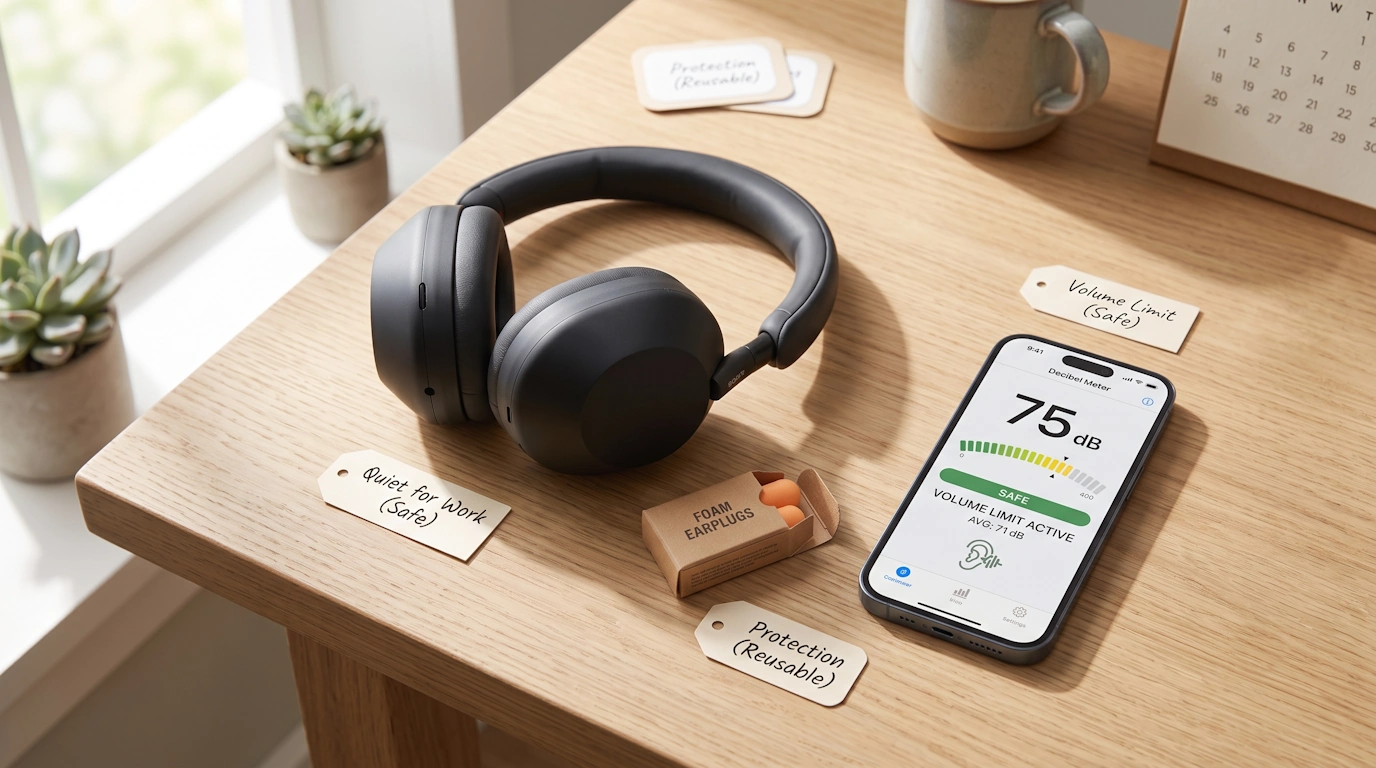
- Follow the 60/60 rule — keep volume at or below 60% of the device maximum, and take a break of at least a few minutes after 60 continuous minutes of listening.
- Use your device's built-in volume limits — both iOS and Android allow you to set a hard headphone volume ceiling; this is especially useful when environmental noise tempts you to turn it up higher than you intend.
- Choose noise-cancelling over volume-boosting — noise-cancelling headphones physically reduce the background sound you're competing with, which removes the most common reason people reach for higher volume. They also double as hearing protection on planes and commutes.
- Avoid in-ear use at maximum volume — earbuds positioned close to the eardrum amplify the effect of the same volume setting compared to over-ear headphones; the same dB number delivers more energy when the driver is in the ear canal.
For more on how volume and duration combine to create risk, see our full guide to noise-induced hearing loss, which covers the dose-duration relationship in detail.
Habit 4 — Support Overall Health
The inner ear is one of the most metabolically active structures in the body, and it's heavily dependent on reliable blood flow. The cochlea's hair cells require a steady supply of oxygen and nutrients — and when circulation is compromised, hearing function can suffer even in the absence of noise damage. Several well-established general health habits have a meaningful bearing on ear health for this reason: they support the vascular system that the inner ear depends on.
Regular aerobic exercise improves circulation and has been associated in observational research with lower rates of age-related hearing decline — likely because it supports cardiovascular health, which in turn maintains blood flow to the cochlea. Quality sleep allows the body — including the auditory system — to carry out repair and recovery processes that don't happen during waking hours. Managing blood pressure matters because hypertension is one of the more consistent risk factors identified in hearing loss research; the cochlea's delicate blood supply is vulnerable to the same arterial changes that affect the heart and kidneys. Avoiding smoking is also relevant: smoking has been associated with higher rates of hearing loss in multiple population studies, likely through its effects on microvascular circulation.
Foods and Nutrients That Support Ear Health
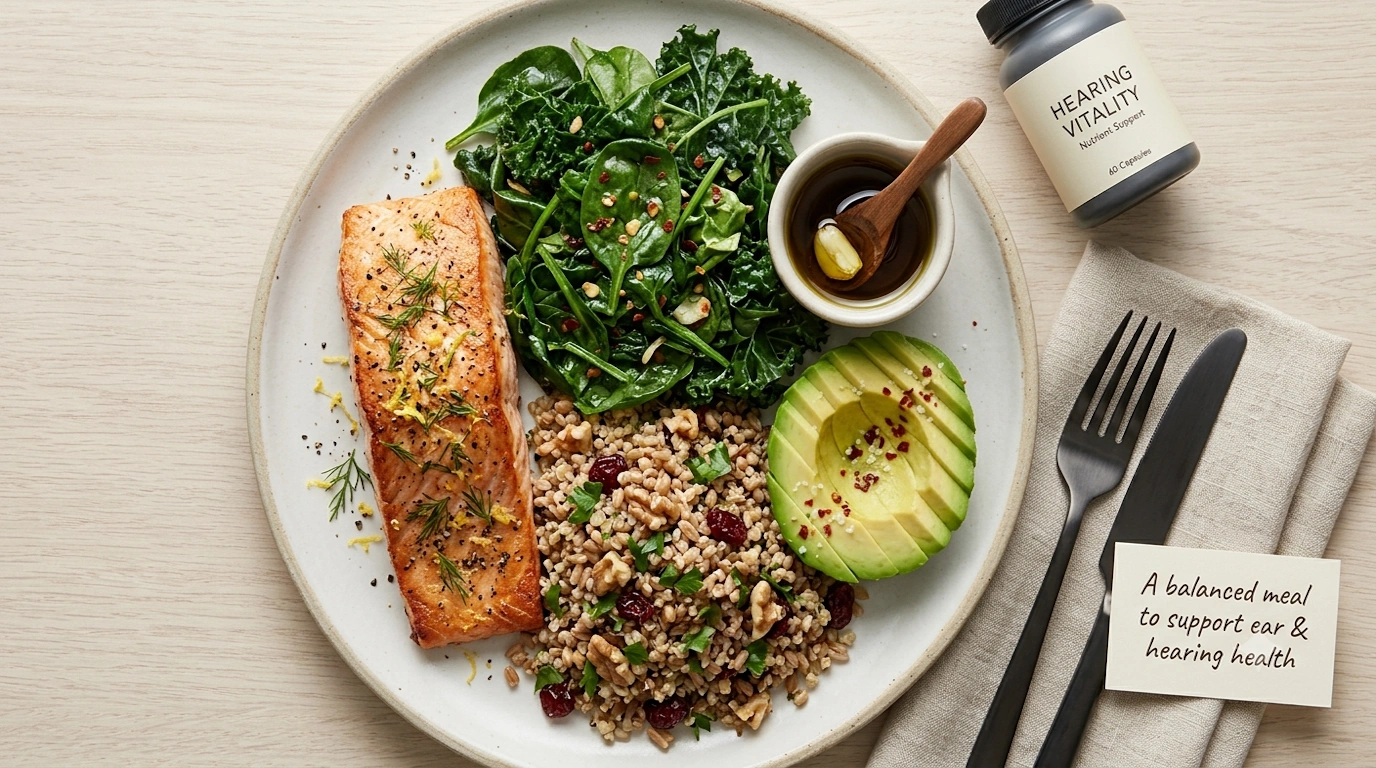
No single food prevents hearing loss, but a consistently balanced diet supports the vascular and cellular health the inner ear depends on. A few nutrients have a specific research thread worth knowing about:
- Omega-3 fatty acids — found in fatty fish (salmon, sardines, mackerel), walnuts, and flaxseed, these are associated with reduced rates of age-related hearing decline in several large observational studies, with researchers pointing to their cardiovascular and anti-inflammatory effects.
- Magnesium — studied in the context of noise-induced hearing damage, where animal models suggest it may help protect hair cells from acoustic trauma. Found in leafy greens, legumes, nuts, and whole grains.
- Antioxidants (vitamins C and E, folate) — oxidative stress is part of the mechanism by which loud sound damages cochlear hair cells; diets rich in antioxidants are associated with lower hearing loss risk in some population data, though direct supplementation evidence is less consistent.
- Limiting excess sodium — high sodium intake contributes to elevated blood pressure, which is one of the more reliably associated risk factors for hearing decline. Managing sodium as part of an overall heart-healthy approach also benefits ear health.
Habit 5 — Get Your Hearing Checked Regularly
Hearing loss tends to be gradual and easy to rationalize away in its early stages. Most people don't self-identify as having hearing difficulty until the changes are significant enough to affect daily conversations — by which point, some of the most useful windows for management have already passed. Routine hearing evaluations close that gap by tracking changes before they become noticeable, providing a documented baseline to compare future tests against, and identifying patterns (like the frequency-specific "noise notch" that signals cumulative noise damage) that wouldn't be apparent otherwise.
The National Institute on Aging recommends adults over 50 discuss hearing with their doctor regularly, with many audiologists advising a baseline evaluation by age 50 and follow-up tests every three to five years if no changes are found — or annually after 65, when age-related changes typically accelerate. Early detection means early options: hearing aids fitted before loss becomes severe tend to produce better outcomes than those started after years of untreated change.
When to Book a Hearing Test Sooner
Tinnitus that persists beyond a day or two — ringing, buzzing, or hissing without an external source, especially if it follows noise exposure, is worth an audiological evaluation rather than a wait-and-see approach.
Trouble following conversations — frequently asking people to repeat themselves, especially in groups or noisy settings like restaurants, is one of the earliest signs of meaningful hearing change.
Creeping TV volume — noticing that you've gradually turned the television louder than you used to, or that others in the room find it too loud at your preferred setting.
One-sided or sudden changes — asymmetric hearing loss or any sudden hearing change deserves prompt evaluation, not because the cause is always serious, but because some causes are time-sensitive if they are.
Simple Daily Routine Checklist
Here's a quick reference for incorporating all five habits into a realistic daily routine. The goal isn't perfection — it's consistency across most days.
Frequently Asked Questions
What daily habits help protect hearing as you age?+
Can hearing loss be prevented?+
Are earbuds bad for hearing health?+
How often should older adults get a hearing test?+
What is the best way to protect hearing at loud events?+
Can better sleep and exercise help hearing health?+
Final Takeaway
Protecting your hearing as you age isn't about a single dramatic intervention — it's about the accumulation of small, consistent choices over years and decades. Keeping volume at a reasonable level, reaching for earplugs when the environment is loud, giving your ears quiet time each day, eating and moving in ways that support circulation, and checking in with an audiologist on a predictable schedule: none of these habits is difficult on its own. What makes them powerful is that they work together, and they compound over time in exactly the way that unaddressed noise damage does.
The earlier these habits take root, the more runway they have. But even starting in your 50s or 60s — long after some cumulative exposure has likely already occurred — can meaningfully slow the rate of further decline and improve your ability to catch and manage changes before they significantly affect daily life. Consistency matters far more than perfection, and small improvements made consistently beat occasional grand gestures every time.
If you're also exploring supplement-based support as part of a broader hearing-health routine, see our ingredient-level Audifort breakdown and our full guide to noise-induced hearing loss for more context on the mechanisms these habits are working to protect against.
Looking for a Supplement to Round Out Your Hearing-Health Routine?
See a full ingredient-by-ingredient evidence breakdown of Audifort and current bundle pricing — backed by a 60-day money-back guarantee.
Check Audifort Pricing →Affiliate link — we may earn a commission at no extra cost to you.
Sources & References
This article draws on the following clinical guidance, government resources, and published research. Links go directly to the original source so you can read the material rather than taking our summary on faith.
- "Age-Related Hearing Loss (Presbycusis)." National Institute on Deafness and Other Communication Disorders (NIDCD), National Institutes of Health. nidcd.nih.gov
- "Deafness and Hearing Loss — Fact Sheet." World Health Organization. who.int
- "Noise and Hearing Loss." National Institute for Occupational Safety and Health (NIOSH), Centers for Disease Control and Prevention. cdc.gov
- "Age-Related Hearing Loss." National Institute on Aging, National Institutes of Health. nia.nih.gov
- "How Loud Is Too Loud?" NIDCD, National Institutes of Health. nidcd.nih.gov
- "Omega-3 Fatty Acid Intake and 12-Year Cumulative Incidence of Hearing Loss." American Journal of Clinical Nutrition / PubMed. pubmed.ncbi.nlm.nih.gov
- "Physical Activity and Hearing Loss: Potential Protective Mechanisms." PMC, National Library of Medicine. ncbi.nlm.nih.gov
- "Hearing Health for Older Adults." American Academy of Audiology. audiology.org
Decibel thresholds reflect current NIOSH occupational guidance; recreational and everyday noise carries the same underlying risk even though the specific limits were written for workplace settings. Nutritional associations cited are from observational studies and should not be interpreted as evidence of direct causation.